

.webp)

Updated: October 2026. This page is updated monthly.
For the first time, a majority of German companies are using AI. Yet, surprisingly little of this has reached the sales department, and hardly any company believes it is getting the most out of what is possible. The real gap lies between "we use ChatGPT" and "AI is working in our pipeline." This page is all about that gap.
We have gathered the latest figures on AI in marketing and sales, specifically for the German B2B mid-market. Every number comes directly from the organization that collected it: Destatis, Eurostat, Bitkom, ifo, Gartner, McKinsey, Salesforce, HubSpot, and others. Nothing is pulled from third-party statistics aggregators. Where studies seem to contradict each other, we explain why: usually, they are measuring different company sizes or asking different questions. You can use any of these figures directly, complete with a link to the source, for presentations or business cases.
Key takeaways
- 57% of companies with 20 or more employees are using AI in 2026, up from 36% in 2025 and 20% in 2024 (Bitkom, Sep 2026).
- 54.5% of companies in Germany are using AI in their business processes, up from 40.9% a year earlier (ifo Institute, Jun 2026).
- Only 9.1% of all German companies with 10 or more employees use AI for marketing or sales (Eurostat, Jun 2026).
- Only 14% of AI-using companies in Germany apply AI in sales, up from 5% the previous year (Bitkom, Sep 2026).
- 91% of German sales teams are already using some form of AI for tasks like prospecting, forecasting, lead scoring, or email (Salesforce, Feb 2026).
- Sales reps spend an average of only 40% of their time actually selling (Salesforce, Feb 2026).
- AI saves sales reps 4.8 hours per week, yet 72% of sales organizations are barely reinvesting that time into value-added work (Gartner, May 2026).
- No German company using AI is fully tapping into its potential; only 3% feel they are making strong use of it (Bitkom, Sep 2026).
- Only about 6% of companies worldwide are AI high-performers, attributing at least 5% of their EBIT to AI (McKinsey, Aug 2026).
- 72% of companies that considered AI but didn't adopt it cite a lack of knowledge as the reason (Destatis, Nov 2025).
- 67% of B2B buyers prefer a completely rep-free purchasing experience (Gartner, Mar 2026).
- In 95% of cases, B2B buyers purchase from a vendor that was on their shortlist from day one (6sense, Nov 2025).
- Marketing leaders expect the AI-automated portion of marketing work to reach 16% rising to 36% by 2028 in 2026 (Gartner, May 2026).
- 11% of German companies that use, plan to use, or are discussing AI are already deploying AI agents (Bitkom, Sep 2026).
How many companies in Germany use AI?
Depending on the study, anywhere from a quarter to more than half of all companies in Germany use AI. Both figures are correct. Official statistics count businesses with as few as 10 employees, while industry associations often start at 20 or use a different industry mix. When comparing figures, always check who was surveyed.
AI adoption: Germany is above the EU average
Share of companies with 10 or more employees using AI
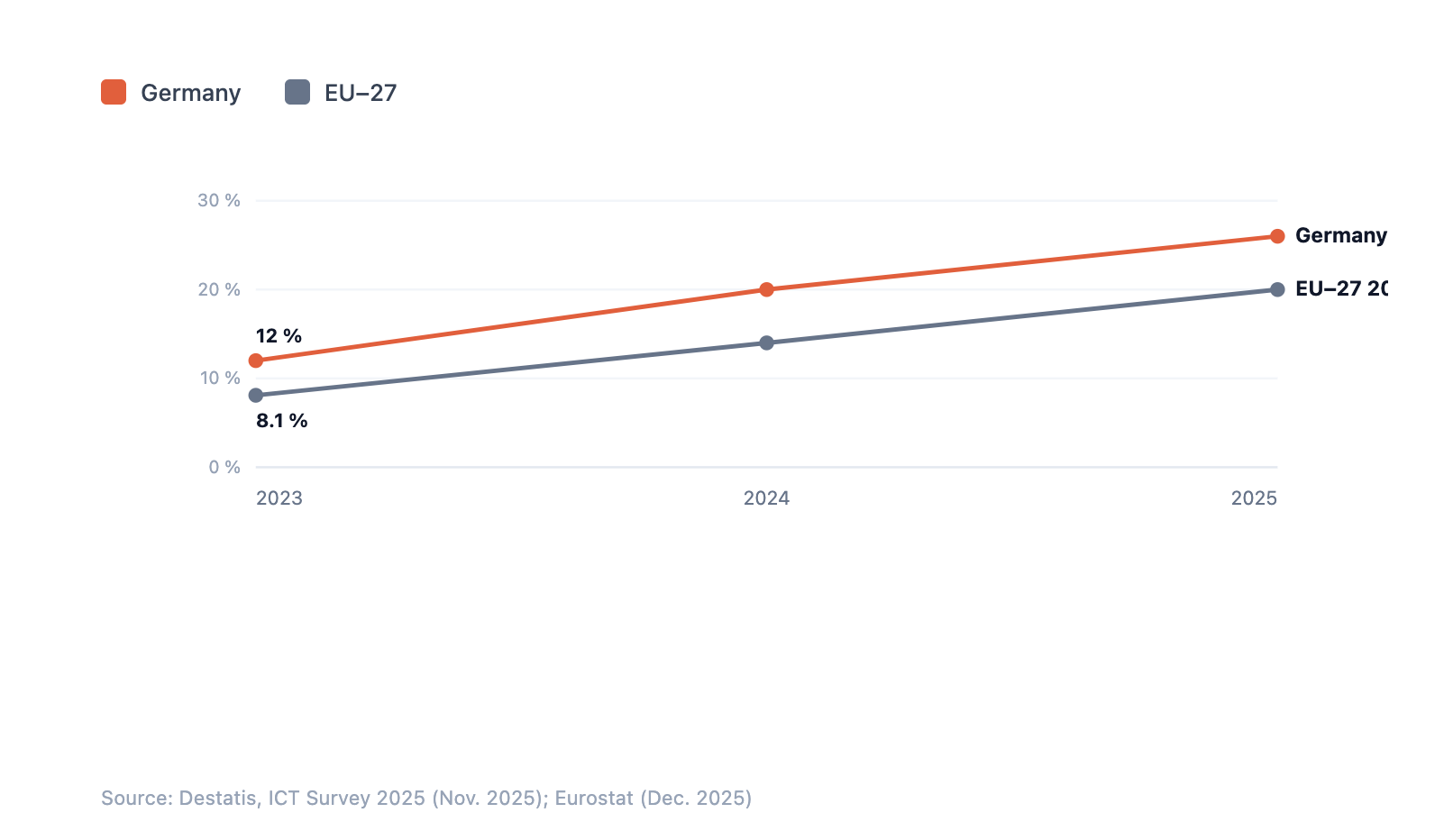
Figure 1: Germany has been above the EU average for AI adoption for years, and the gap remains consistent. Source: Destatis, ICT Survey 2025, Nov 2025, and Eurostat, Dec 2025. Own representation of published values, created on Oct 2, 2026.
How many companies use AI according to official statistics?
According to the Federal Statistical Office, about one in four companies uses AI, while for large enterprises, the figure is more than half.
- 26% of companies in Germany with at least 10 employees used AI technologies in 2025 (Destatis, Nov 2025).
- In 2025, 57% of companies with more than 250 employees used AI, compared to just 36% of companies with 50 to 249 employees and 23% of those with 10 to 49 employees (Destatis, Nov 2025).
- In 2024, 20% of companies with 10 or more employees used AI, up from 12% in 2023 (Destatis, Nov 2024).
- 20% of small and medium-sized enterprises used at least one AI technology between 2022 and 2024, compared to 4% between 2016 and 2018 (KfW Research, Jul 2026).
What do the latest 2026 surveys show?
The 2026 surveys show that AI is no longer a niche topic for almost any company. However, small and medium-sized enterprises are lagging behind larger corporations.
- Another 38% of companies with 20 or more employees are planning or discussing the use of AI (Bitkom, Sep 2026).
- Only 4% of companies now say that AI is not a topic for them, down from 17% last year and 41% two years ago (Bitkom, Sep 2026).
- 91% of companies consider AI to be the most important future technology, up from 81% in 2025 (Bitkom, Sep 2026).
- 16% of companies are planning to use AI, and another 21.6% are discussing it (ifo Institute, Jun 2026).
- 67.2% of large companies use AI, but only 51.2% of small and 47.2% of medium-sized companies do (ifo Institute, Jun 2026).
- In the construction industry, the share of AI users rose from 7.1% to 39.8% within three years, while in the manufacturing sector it stands at 58.7% (ifo Institute, Jun 2026).
Which AI are German companies using?
Most companies purchase AI solutions, with barely one in five developing their own systems. They most frequently use them to process text and speech.
- Nearly three-quarters of companies using AI employ paid external AI solutions, 22.5% use only free systems, and 18.7% develop their own AI systems (ifo Institute, Jun 2026).
- Of the companies using AI, 52% use text mining, 42% use speech recognition, and 35% use natural language generation, including programming code (Destatis, Nov 2025).
- Almost 60% of companies in the information economy provide their staff with specific generative AI tools, compared to 30% in the manufacturing sector (ZEW, Jun 2026).
- 70% of all companies now train their employees in how to use AI, with 11% training their entire workforce (Bitkom, Sep 2026).
- 25% of companies offer no AI training at all, down from 43% the previous year (Bitkom, Sep 2026).
How does Germany compare to the rest of the EU?
Germany is above the EU average, but Scandinavia and Austria are further ahead.
- 20.0% of EU companies with at least 10 employees used AI in 2025, up from 13.5% in 2024 and 8.1% in 2023 (Eurostat, Dec 2025).
- In 2025, the leaders in the EU were Denmark at 42.0%, Finland at 37.8%, and Sweden at 35.0% (Eurostat, Dec 2025).
- Across the EU in 2025, 55.03% of large, 30.36% of medium-sized, and 17% of small businesses used AI (Eurostat, Dec 2025).
- In Austria, 30% of companies with 10 or more employees used AI technologies in 2025, compared to 9% in 2021 (Statistics Austria, Jun 2026).
AI in marketing: Who is using what?
Marketing is the area where AI has taken hold the fastest. The reason is obvious: text, images, and variations are exactly what generative AI does best. Even so, across all companies, AI in marketing is still the exception.
What marketers use AI for
Share of marketers using AI for specific tasks, 2026

Figure 2: About four out of five marketers use AI for content, but only a good two out of five use it intensively. For most teams, the step from "occasional" to "fully integrated into the process" is still ahead. Source: HubSpot, 2026 State of Marketing, Apr 2026. Own representation of published data, created on Oct 2, 2026.
How many companies use AI in marketing?
Among AI users, marketing is one of the most important areas of application. Depending on the study, between one-third and a good two-thirds of them use AI in marketing.
- 35.1% of AI-using companies in Germany used AI for marketing or sales in 2025 (Eurostat, Jun 2026).
- Across the EU, 34.7% of AI-using companies used AI for marketing or sales in 2025 (Eurostat, Dec 2025).
- 54% of AI-using companies with 20 or more employees use AI in marketing and communications (Bitkom, Sep 2026).
- In the previous year, 57% of AI-using companies used AI in marketing and communications (Bitkom, Sep 2025).
- Nearly 7 out of 10 AI-using companies use AI in marketing and sales, making it the most common area of application (Federal Network Agency, Jul 2025).
- Three out of four AI-using companies use AI to generate text, speech, images, or code (Federal Network Agency, Jul 2025).
How widespread is AI in marketing teams?
AI has arrived almost everywhere in marketing teams, but implementation is currently struggling, especially in Europe.
- 86.4% of marketing teams worldwide use AI in at least some areas of marketing (HubSpot, Apr 2026).
- 75% of marketing decision-makers worldwide have adopted AI (Salesforce, Feb 2026).
- 95% of B2B marketers say their organization uses AI-powered applications (Content Marketing Institute, Oct 2025).
- 94% of marketing leaders surveyed in Europe have yet to make significant progress in adopting AI (McKinsey, Nov 2025).
What are marketers using AI for?
Marketers most frequently use AI to create content. Personalization is considered the most important next step.
- 42.5% of marketers use AI extensively for content creation, with another 38% using it occasionally (HubSpot, Apr 2026).
- 37.2% of marketers use AI extensively for image and video production, with another 37.7% using it occasionally (HubSpot, Apr 2026).
- 34.1% of marketers use AI extensively for ad automation and optimization, with another 36.5% using it occasionally (HubSpot, Apr 2026).
- 48.57% of marketers cite "using AI for personalized content" as the most important marketing trend (HubSpot, Apr 2026).
- 89% of B2B marketers use or are currently implementing AI tools for text, 53% for images and videos, and 41% for SEO (Content Marketing Institute, Oct 2025).
How is AI search changing marketing?
AI search is changing visibility, and most marketers have already taken action.
- 88% of marketing decision-makers are already optimizing for AI-generated answers, such as those in ChatGPT (Salesforce, Feb 2026).
- 85% of marketers say that AI is changing their SEO strategy (Salesforce, Feb 2026).
- 86% of B2B communicators in the industrial and service sectors in Germany believe that optimization for AI search engines is necessary (bvik, Jan 2026).
How much money is being invested in AI in marketing?
AI has arrived in the marketing plan, with high expectations and a noticeable share of the budget.
- 51% of the companies surveyed believe that generative AI is already handling a significant portion of creative marketing work today (Bitkom, Feb 2026).
- 84% of the companies surveyed consider AI to be one of the most influential marketing trends through 2027 (Bitkom, Feb 2026).
- CMOs in North America, the UK, and Europe are investing an average of 15.3% of their marketing budgets in AI initiatives (Gartner, May 2026).
AI in Sales: From Tools to Agents
Many sales professionals have long been using ChatGPT to write their emails. However, only a small minority of companies are using AI systematically in their sales processes. This gap between individual use and established process is the biggest untapped opportunity in B2B sales.
What sales professionals use AI for
Percentage of sales professionals using AI for specific tasks
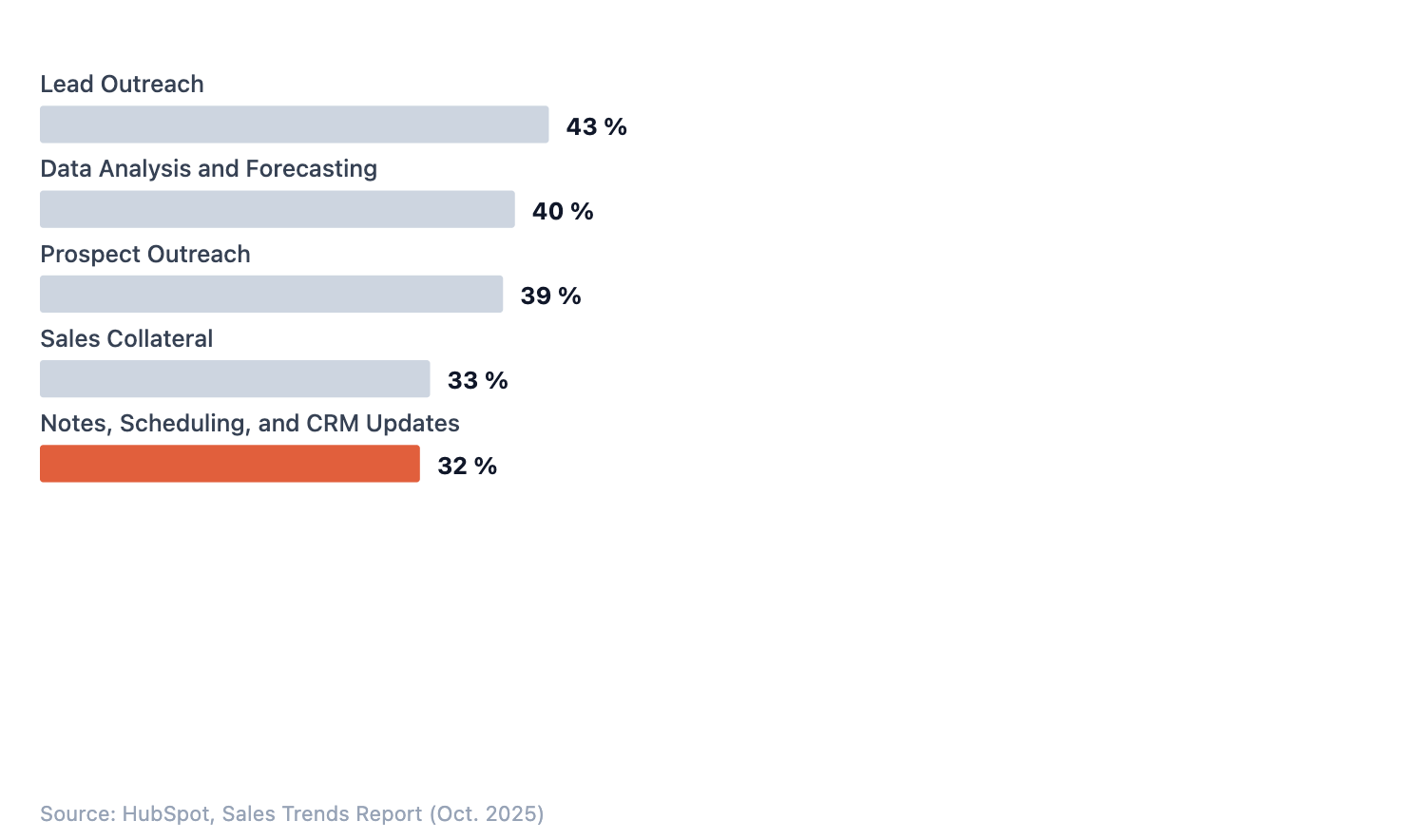
Figure 3: Sales professionals primarily use AI to write text. The work behind the pipeline—such as notes, scheduling, and CRM maintenance—is at the bottom of the list, even though that is where the most time is lost. Source: HubSpot, Sales Trends Report, Oct 2025. Own representation of published data, created on Oct 2, 2026.
How many sales teams are using AI?
Almost all sales teams use AI in some form, and more than half of sales professionals use it daily.
- 87% of sales organizations worldwide use some form of AI, for tasks such as prospecting, forecasting, lead scoring, or drafting emails (Salesforce, Feb 2026).
- Only 8% of sales professionals do not use AI at all (HubSpot, Oct 2025).
- 56% of sales professionals use AI daily (LinkedIn, Mar 2025).
- 72% of companies in Germany using AI apply it to customer interactions, such as handling inquiries (Bitkom, Sep 2026).
How far along are AI agents in sales?
AI agents are already part of everyday life in sales, and German sales professionals are ahead of the global average.
- 54% of sales professionals worldwide have already used AI agents (Salesforce, Feb 2026).
- 59% of German sales staff have already used AI agents (Salesforce, Feb 2026).
What do sales professionals use AI for?
Sales professionals primarily use AI for writing and research. CRM tasks come only after that.
- 55% of sales pros use AI for prospecting, and another 38% are planning to (Salesforce, Feb 2026).
- 43% of sales professionals use AI for lead outreach, 39% for prospect outreach, and 33% for sales materials (HubSpot, Oct 2025).
- 40% of sales reps use AI for data analysis and forecasting, while 32% use it to automate notes, scheduling, and CRM updates (HubSpot, Oct 2025).
What sets successful sales teams apart?
Successful teams use AI more often, but more importantly, they use it more systematically: with clean data, actionable insights, and well-trained staff.
- Top-performing sales teams use AI agents 1.7 times more often than their lower-performing counterparts (Salesforce, Feb 2026).
- 77% of top-performing sales professionals in Germany prioritize data hygiene, compared to 54% of those who are less successful (Salesforce, Feb 2026).
- Sales reps who effectively collaborate with AI tools are 3.7 times more likely to hit their quotas than others (Gartner, Sep 2024).
- Sales organizations that provide their reps with AI-powered next best actions are 2.6 times more likely to achieve commercial growth (Gartner, May 2026).
- Organizations that prioritize AI upskilling for their sales teams are 2.4 times more likely to see strong revenue growth (Gartner, May 2026).
- Sales professionals who use AI daily are twice as likely to exceed their targets compared to others (LinkedIn, Mar 2025).
Where marketing and sales teams lose time
In most B2B teams, lead-related tasks eat up a huge chunk of time: reconciling data, sorting through inboxes, and hunting for information. This work doesn't show up in any reports, so it stays invisible. That’s exactly where automation comes in.
Work inboxes are getting fuller every year
Average number of work emails per day, per inbox in Germany
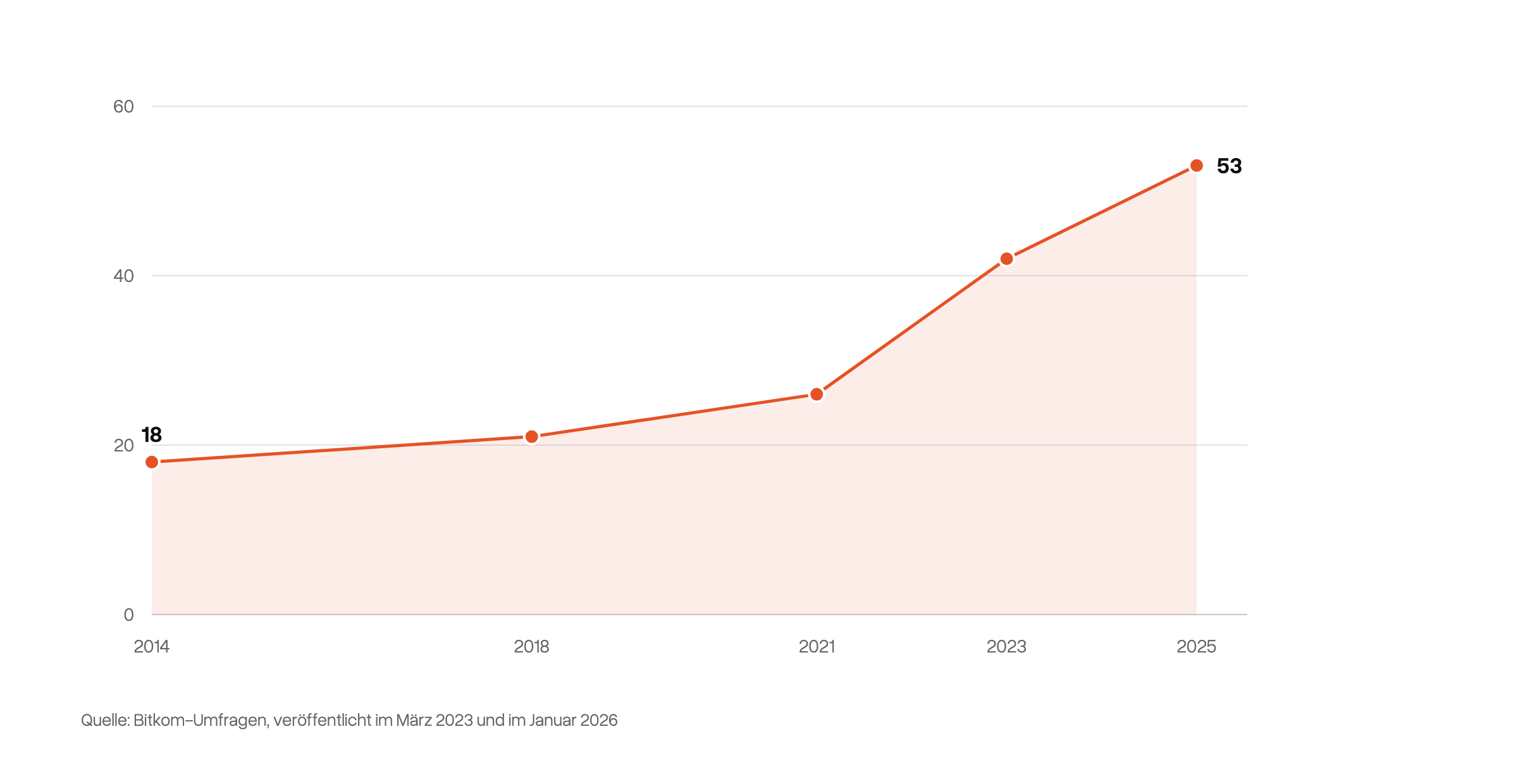
Figure 4: The number of work emails per day has nearly tripled since 2014. Each one needs to be read, categorized, and answered. Source: Bitkom, Professional email traffic reaches a new high, Jan 2026, and Bitkom, Work email inboxes becoming increasingly full, Mar 2023. Own representation of published values, created on Oct 2, 2026.
How much time do sales reps actually spend selling?
Less than half their time, and even less for those just starting out. The rest is lost to data entry and coordination.
- Gen Z sales reps spend only 35% of their time selling and lose about two full hours a week to manual data entry (Salesforce, Feb 2026).
- 65% of sales reps lose at least one workday per month reconciling data between systems (HubSpot, Sep 2026).
How heavy is the communication burden?
For many employees, the inbox is the biggest time trap, and it’s getting fuller every year.
- In the average German workday, 53 work emails are received daily, with 14% of professionals receiving 100 or more (Bitkom, Jan 2026).
- Employees worldwide receive an average of 117 emails per day, most of which are skimmed in less than 60 seconds (Microsoft, Jun 2025).
- Employees are interrupted every two minutes during core working hours—a total of 275 times a day—by meetings, emails, or chats (Microsoft, Jun 2025).
- 80% of employees and managers worldwide say they lack the time or energy to get their work done (Microsoft, Apr 2025).
Where else does work time disappear?
A lot of time is lost to searching, coordinating, and managing. This is time that could be spent on actual work.
- Managers and teams spend a quarter of their work week searching for information (Atlassian, Mar 2025).
- 56% of knowledge workers often only get the information they need by asking someone or scheduling a meeting (Atlassian, Mar 2025).
- Knowledge workers spend 58% of their workday on "work about work," meaning coordination and alignment tasks that aren't actual specialized work (Asana, Mar 2023).
- Unnecessary meetings cost knowledge workers 2.8 hours per week, and managers 3.6 hours (Asana, Mar 2023).
- German SMEs spend 7% of their working time on bureaucracy, averaging 32 hours per month per company (KfW Research, Apr 2025).
How quickly do B2B companies respond to leads?
Many companies take hours to respond to an inquiry, and some don't respond at all. For a prospect talking to three providers at once, that’s an eternity.
- B2B companies took an average of 11 hours and 54 minutes to respond to a demo request via email, and nearly one in five didn't respond via email at all (Workato, Mar 2026).
How much time does AI save?
Depending on the team, AI saves several hours a week, and often significantly more for marketing teams. The potential is even greater.
- About a third of marketing teams save 10 to 14 hours per week thanks to AI, and another third save more than 15 hours (HubSpot, Apr 2026).
- Sales teams expect AI agents to reduce their research time by 34% (Salesforce, Feb 2026).
- Sales teams expect AI agents to cut content creation time by 36% (Salesforce, Feb 2026).
- Generative AI and other technologies have the potential to automate tasks that currently take up 60 to 70% of employees' time (McKinsey, Jun 2023).
If you want to know which of these time-wasters can be automated in your team, check out our use case overview where we show workflows for your inbox, quotes, document capture, and CRM maintenance.
Does AI actually pay off?
Yes, but so far only for a minority. Most companies are seeing productivity gains, but few are seeing increased revenue. The pioneers have one thing in common: they’ve rebuilt their processes around AI.
What AI users in Germany are reporting
Share of companies using AI, 2026
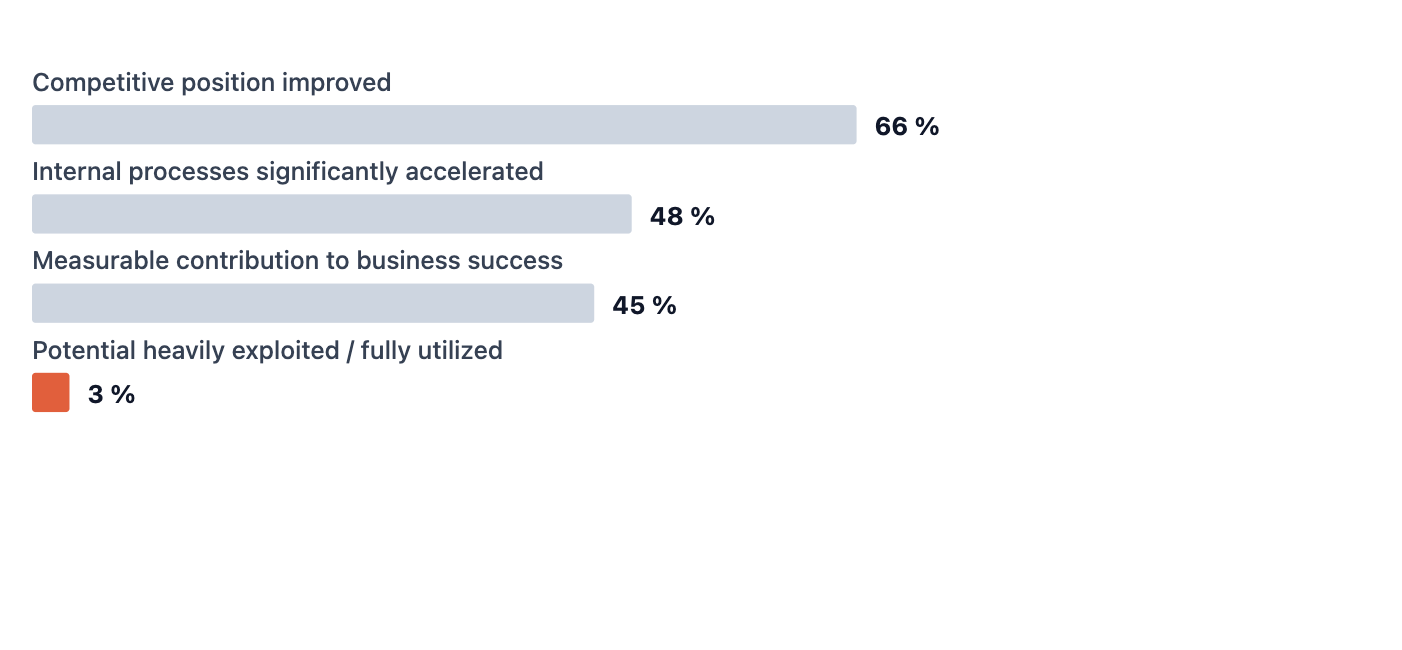
Figure 5: Two-thirds of German AI users say their competitive position has improved. However, only 3% say they are fully tapping into the potential. There is a significant gap between initial results and real value creation. Source: Bitkom, For the first time, the majority of companies are using AI, Sep 2026. Own representation of published data, created on Oct 2, 2026.
How many companies are seeing measurable benefits from AI?
A good third of companies worldwide are seeing an impact on their bottom line, but only about one in five is generating more revenue.
- 37% of respondents attribute at least part of their EBIT to AI adoption, about the same as the previous year (McKinsey, Aug 2026).
- 44% of respondents say that AI is being scaled company-wide, up from 38% a year ago (McKinsey, Aug 2026).
- Around 48% of companies are now generating value from AI, compared to just 5% with substantial value in 2025 (BCG, Sep 2026).
- 66% of companies report productivity and efficiency gains from AI, but only 20% are seeing increased revenue, even though 74% are hoping for it (Deloitte, Jan 2026).
- According to CEOs, only 25% of AI initiatives have delivered the expected ROI in recent years, and only 16% have been scaled company-wide (IBM, May 2025).
What are German AI users reporting?
German AI users are generally satisfied. However, less than half see a measurable contribution to their success.
- 66% of AI-using companies in Germany have improved their competitive position through AI (Bitkom, Sep 2026).
- 48% of AI users have significantly accelerated their internal processes through AI, and 45% see a measurable contribution to company success (Bitkom, Sep 2026).
What sets leaders apart from laggards?
Leaders have rebuilt their workflows and are investing significantly more. The gap between them and the laggards is growing.
- Nearly three-quarters of AI high-performers have fundamentally redesigned their workflows because of AI, compared to only a quarter of other companies (McKinsey, Aug 2026).
- AI leaders achieve 2.4x the revenue growth, 2.8x the EBITDA growth, and 2.3x the total shareholder return compared to laggards (BCG, Sep 2026).
- 90% of respondents say their company uses AI, but only 6% classify themselves as "transformative" AI users (HubSpot, Sep 2026).
- Transformative AI users are four times more likely to hit their revenue targets than others (HubSpot, Sep 2026).
- High-growth B2B companies were three times more likely to increase their AI investments by double digits in 2026, at 71% compared to 25% (McKinsey, Jul 2026).
What are the effects on marketing and sales?
Marketing and sales are among the areas with the greatest value potential. However, returns vary widely.
- AI-powered next-best-experience programs in B2B sales have delivered 5 to 8% more revenue and 20 to 30% lower cost-to-serve (McKinsey, Jul 2026).
- 25% of sales organizations report a return of 50% or more on their AI investments, while 20% report a negative return of 50% or more (Gartner, May 2026).
- Only 30% of CMOs have the mature capabilities needed to scale AI (Gartner, May 2026).
- 70% of AI's value potential lies in core functions like sales and marketing (BCG, Sep 2025).
- Generative AI could boost marketing productivity by an amount equal to 5% to 15% of total marketing spend (McKinsey, Jun 2023).
- About 75% of the value potential from generative AI is concentrated in four areas: customer service, marketing and sales, software engineering, and R&D (McKinsey, Jun 2023).
What's holding back AI projects
The biggest hurdle is a lack of knowledge. Companies without AI lack the know-how to implement it, while those already using AI struggle with legal issues, data privacy, and data quality. Both are solvable, but rarely while trying to manage day-to-day operations at the same time.
Why companies are skipping AI
Reasons cited by companies that considered but did not adopt AI, 2025
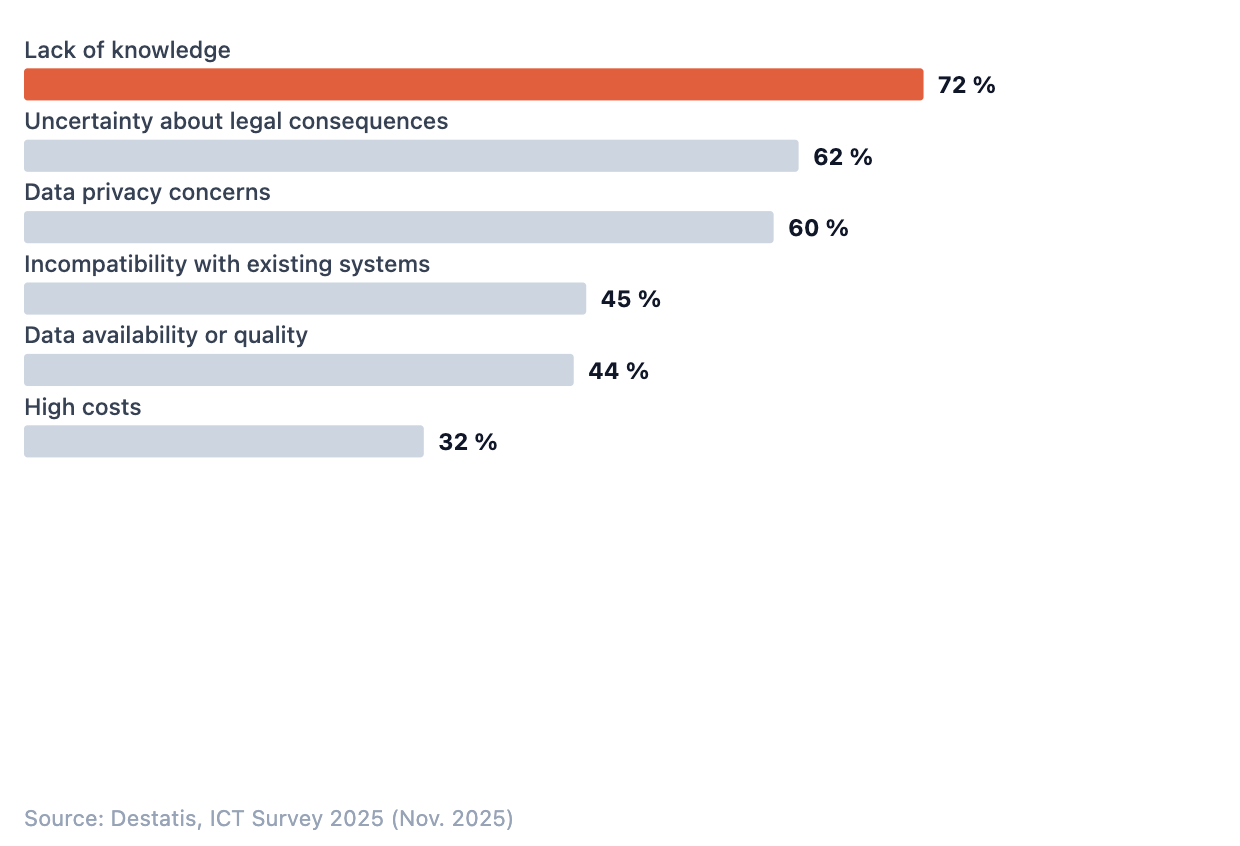
Figure 6: A lack of knowledge is more than twice as likely to be a barrier as high costs. To successfully adopt AI, you need practical implementation expertise. Source: Destatis, reasons for not using AINov 2025. Data based on our own analysis of published figures, created on Oct 2, 2026.
Why aren't companies adopting AI?
Beyond a lack of knowledge, legal uncertainty and data protection are the main factors holding things back. Technology and costs only come into play after that.
- 62% of companies that have considered but not adopted AI cite uncertainty about the legal consequences as a barrier (Destatis, Nov 2025).
- 60% of these companies say concerns about data protection and privacy are keeping them from using AI (Destatis, Nov 2025).
- 45% mention incompatibility with existing equipment, software, and systems (Destatis, Nov 2025).
- 44% cite difficulties with the availability or quality of the required data (Destatis, Nov 2025).
- 85% of companies without AI lack the technical know-how for implementation (Bitkom, Sep 2026).
- 66% of companies without AI feel discouraged from using it due to confusing legal hurdles and uncertainties (Bitkom, Sep 2026).
- 63% of companies without AI are put off by costs that are hard to calculate, compared to 54% of those already using AI (Bitkom, Sep 2026).
- Across the EU, 70.89% of companies that have considered AI cite a lack of expertise as the primary reason for not moving forward, followed by unclear legal implications at 52.52% and data protection concerns at 48.83% (Eurostat, Dec 2025).
How well prepared are employees?
Not very well, according to the companies themselves, even though training opportunities are on the rise.
- 66% of companies rate their employees' AI skills as low, while only 28% rate them as high (Bitkom, Sep 2026).
- 27% of companies have already trained their staff in using AI, while 45% currently see no need for AI-related professional development (TÜV-Verband, Apr 2026).
Note: Bitkom and TÜV-Verband report very different figures regarding training. Bitkom surveys companies with 20 or more employees that offer any form of training, even for select staff. TÜV-Verband asks whether employees have actually received training.
To what extent does data protection hold things back?
For one in two companies, data protection is a hurdle for internal AI adoption. Many even avoid non-European solutions as a result.
- 50% of companies say that data protection hinders the use of AI within their own organization (Bitkom, Sep 2026).
- 42% of companies have already opted against products or solutions from countries outside the EU due to data protection concerns (Bitkom, Sep 2026).
What does the AI Act mean for businesses?
The AI Act is being rolled out in stages. Authorities have been enforcing it since August 2026, and affected companies are bracing for a significant workload.
- 89% of companies that are affected by the AI Act—or are currently assessing their status—expect a high implementation burden, with 51% anticipating a very high one (Bitkom, Sep 2026).
- The AI Act has been in effect since August 1, 2024, and the AI Office and member state authorities have been enforcing it since August 2, 2026 (European Commission, Aug 2026).
How common is shadow AI?
Shadow AI is on the rise. Most companies don't want to ban AI tools, but they often lack clear guidelines for their use.
- In 8% of companies, the use of private AI accounts by employees is widespread—up from 4% in 2024—with another 17% reporting isolated cases (Bitkom, Oct 2025).
- Only 4% of companies in the information sector and 8% in the manufacturing industry ban generative AI, while 22% and 39% respectively tolerate it without any clear guidelines (ZEW, Jun 2026).
Why do AI projects fail?
The most common reason for AI project failure is a lack of data or poorly prepared data.
- According to Gartner, by the end of 2026, companies will abandon 60% of AI projects that lack AI-ready data. 63% of companies either have no appropriate data management practices in place or are unaware of them (Gartner, Feb 2025).
A lack of implementation expertise is the most common hurdle. We’d love to discuss how an external team can bridge that gap without you needing to hire internally in an initial consultation.
B2B buyers are researching with AI
By the time sales hears from a customer for the first time, the decision has often already been made. Buyers are researching with ChatGPT and similar tools, putting together their own shortlists, and only reaching out late in the game. If you don't show up in the AI's answers, you won't even make the list. We show you how to change that in our guide How to build your GEO strategy.
AI summaries cost clicks
Share of Google visits resulting in a click on a traditional search result, USA, March 2025
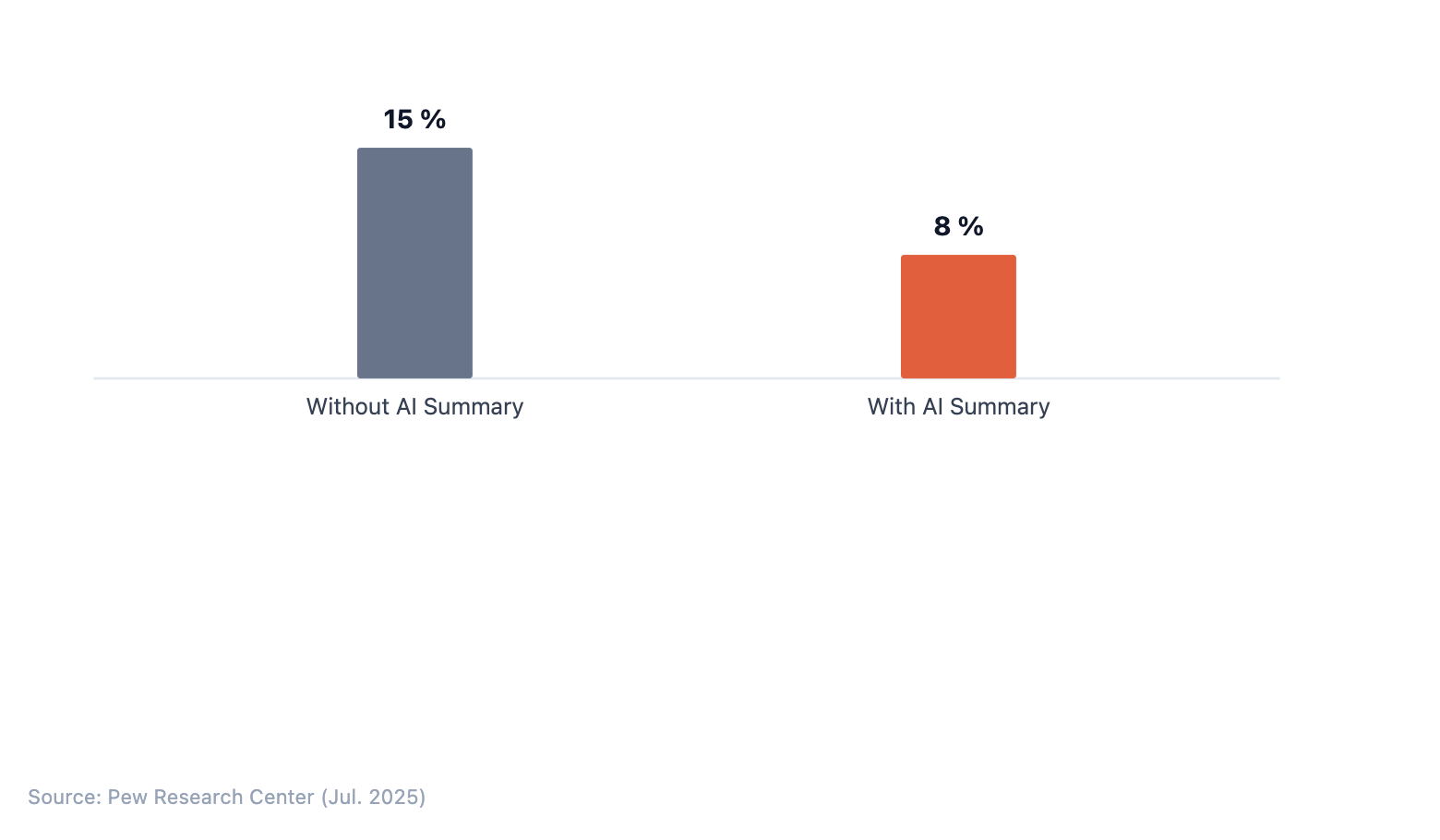
Figure 7: When an AI summary appears, the share of visits where someone clicks on a traditional search result is cut almost in half. Visibility in the AI answer is therefore becoming a prerequisite for traffic. Source: Pew Research Center, Google users are less likely to click on links when an AI summary appears, Jul 2025. Own representation of published values, created on Oct 2, 2026.
How many B2B buyers use AI?
Almost all B2B buyers use AI. The frequently cited figure of 94% comes from two independent studies that measure different things.
- 94% of B2B buyers use large language models (LLMs) during the purchasing process (6sense, Nov 2025).
- 94% of business buyers say they use AI in the purchasing process (Forrester, Jan 2026).
- 45% of B2B buyers used generative AI for their last purchase, using an average of seven information sources (Gartner, May 2026).
- 92% of US B2B professionals who use AI at work say that AI has influenced their shortlist of vendors (Semrush, Jul 2026).
When is the buying decision made?
The buying decision happens earlier than sales teams think. The first point of contact doesn't occur until the vendor ranking is already set.
- B2B buyers don't reach out to sales until they are 61% of the way through their buying journey, compared to 69% in 2024 (6sense, Nov 2025).
- 94% of buying groups rank their preferred vendors before making first contact and end up buying from their early favorite 77% of the time (6sense, Nov 2025).
- A typical B2B buying decision involves 13 internal stakeholders and nine external influencers (Forrester, Jan 2026).
- 69% of B2B buyers prefer to have AI-generated insights verified by sales representatives (Gartner, May 2026).
How does AI search affect website traffic?
AI summaries are costing traditional search results a significant portion of their clicks.
- With an AI summary, users click on a traditional search result in only 8% of visits, compared to 15% without a summary (Pew Research Center, Jul 2025).
- Around one in five Google searches (18%) generated an AI summary in March 2025 (Pew Research Center, Jul 2025).
- When an AI Overview is displayed, the click-through rate for the number one position drops by about 58% (Ahrefs, Feb 2026).
- For search queries with an AI Overview, the organic click-through rate fell by 61% between June 2024 and September 2025, dropping from 1.76% to 0.61% (Seer Interactive, Nov 2025).
How widely is AI search used in Germany?
Half of all internet users in Germany already use AI chat for searching at least occasionally, and among younger people, it's the vast majority.
- 50% of internet users in Germany use AI chats instead of traditional search engines at least occasionally, and among 16- to 29-year-olds, that figure is two-thirds (Bitkom, Nov 2025).
- 67% of Germans aged 16 and over use generative AI at least occasionally, with 43% using ChatGPT (Bitkom, May 2025).
- 59% of the German-speaking population aged 14 and over use AI tools at least occasionally, rising to 92% among 14- to 29-year-olds (ARD/ZDF Media Study, Sep 2026).
- Only 5% of respondents in Germany used an AI chatbot to get news in the past week (Hans-Bredow-Institut, Jun 2026).
Outlook: AI agents in marketing and sales
The next level involves agents that handle entire workflows on their own. Budgets for this are already rising, but implementation is lagging behind. Agents are only effective if data and processes are properly set up. Without this foundation, many projects will end up in the failure statistics that Gartner predicts below.
Spending on AI agents and assistants
Worldwide, in billions of US dollars
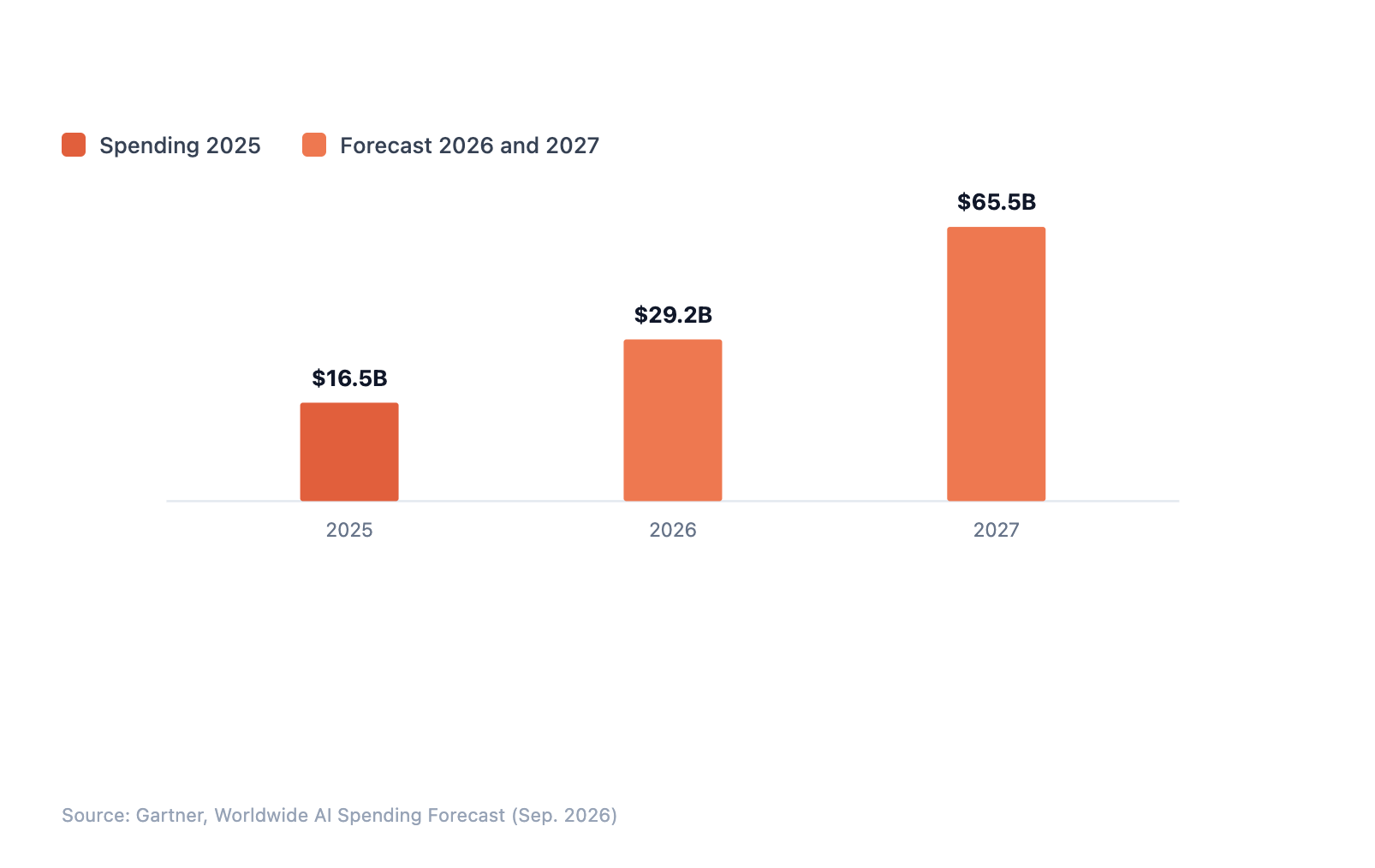
Figure 8: According to Gartner's forecast, spending on AI agents and assistants will quadruple between 2025 and 2027. Values for 2026 and 2027 are projections. Source: Gartner, Worldwide AI Spending Forecast, Sep 2026. Own representation of published values, created on Oct 2, 2026.
How many companies are already using AI agents?
Many companies are building AI agents, but hardly any have fully scaled them yet.
- 29% of German companies that use AI are planning to deploy AI agents, and another 31% are discussing it (Bitkom, Sep 2026).
- 40% of respondents from companies with over $1 billion in revenue are scaling AI agents, up from 27% the previous year (McKinsey, Aug 2026).
- 62% of large US companies are building, developing, or operating AI agents, compared to 53% in the previous quarter (KPMG, Sep 2026).
- Only 2% of companies have fully scaled AI agents in production (Capgemini Research Institute, Jul 2025).
- Nearly three-quarters of companies plan to use agentic AI within two years, but only 21% of them have a mature governance model for agents (Deloitte, Jan 2026).
What do marketing and sales expect from agents?
Expectations are high, but productivity forecasts are mixed.
- Nearly 9 out of 10 sales professionals plan to use AI agents by 2027 (Salesforce, Feb 2026).
- By 2028, Gartner predicts there will be ten times as many AI agents as human salespeople, yet fewer than 40% of sellers will say that agents have improved their productivity (Gartner, Nov 2025).
- According to Gartner forecasts, at least 15% of everyday work decisions will be made autonomously by agentic AI by 2028, up from 0% in 2024 (Gartner, Jun 2025).
- According to Gartner forecasts, more than 40% of agentic AI projects will be discontinued by the end of 2027 due to rising costs, unclear business value, or inadequate risk controls (Gartner, Jun 2025).
Where is the budget going?
AI budgets continue to rise, with a growing share being funneled into agents.
- 45% of German companies will spend more on AI in 2026 than in the previous year, with 13% spending significantly more (Bitkom, Sep 2026).
- Global AI spending is projected to reach $1.3 trillion by 2029, driven by agentic AI applications, according to IDC (IDC, Aug 2025).
- According to forecasts by the Capgemini Research Institute, agentic AI could generate up to $450 billion in economic value by 2028 (Capgemini Research Institute, Jul 2025).
What does this mean for employment?
Many companies expect AI to reduce their headcount, but rarely anticipate drastic cuts.
- 57% of German companies expect a decline in their number of employees due to AI over the next two years, with 45% expecting a slight decrease and 12% a significant one (Bitkom, Sep 2026).
- 39% of respondents worldwide expect an AI-driven decline in total employment at their company over the coming year, up from 32% the previous year (McKinsey, Aug 2026).
- 41% of employers worldwide plan to reduce their workforce as AI automates certain tasks (World Economic Forum, Jan 2025).
Bottom line: What these numbers mean for your team
AI has arrived in the majority of German companies. However, it is rarely integrated into established workflows in marketing and sales: only 9.1% of all companies with 10 or more employees use AI for marketing or sales, and only 14% of AI users apply it in sales. The companies that are seeing measurable benefits have rebuilt their processes around AI. The biggest obstacle to getting there is a lack of implementation expertise.
The best way to start: Pick a workflow where your team currently loses a lot of time, such as processing new inquiries or updating the CRM after meetings, and automate it from start to finish. Measure the time per task before and after. Then you'll have your first solid business case.
FAQ: Frequently asked questions about AI in marketing and sales
How many companies in Germany use AI?
Depending on the survey, between 26% and 57%. In 2025, Destatis counted 26% of companies with 10 or more employees, while the ifo Institute reported 54.5% in 2026, and Bitkom reported 57% of companies with 20 or more employees. The differences are primarily due to company size and the specific questions asked.
How many companies use AI in marketing?
Looking at all companies with 10 or more employees, only 9.1% in Germany use AI for marketing or sales (Eurostat). Among companies that already use AI, the figure ranges from 35% to nearly 70%, depending on the study.
How much time does AI save in sales?
According to Gartner, an average of 4.8 hours per week per sales representative. However, 72% of sales organizations barely invest this time in value-added work (May 2026).
Is AI worth it in marketing and sales?
For a growing number of companies, yes. According to McKinsey, 37% attribute at least part of their EBIT to AI, while Deloitte reports that 66% see productivity gains, though only 20% report higher revenue. According to Gartner, returns in sales vary widely.
What is the biggest hurdle for AI adoption?
Lack of knowledge. 72% of companies that considered but did not implement AI cite this as the reason (Destatis). This is followed by uncertainty regarding legal consequences at 62% and data privacy concerns at 60%.
Methodology
For this page, we have only included figures that we found and verified on the websites of the organizations conducting the surveys: government agencies, research institutes, associations, and companies publishing their own research. Aggregator sites, blogs, and press reviews served only as leads. Every figure is cited with the source's month of publication.
Many studies measure different populations. Destatis and Eurostat cover all companies with 10 or more employees, Bitkom surveys companies with 20 or more employees, and the ifo Institute asks questions as part of its business climate surveys. Percentages sometimes refer to all companies and sometimes only to those already using AI. We therefore specify the population for every figure and do not mix values from different studies. Many sales and marketing studies are international. Where German data is available, we contrast it with global figures.
The charts are our own representations of the published data, with the source provided below each one. We update this page monthly as soon as new surveys are released.
Glossary
- AI Act: EU regulation on artificial intelligence that classifies AI systems by risk level and has been implemented in stages since 2024.
- AI Overview: An AI-generated summary that Google displays above traditional search results.
- Agentic AI / AI Agent: An AI system that independently plans and executes multiple steps, such as researching a lead, evaluating it, and drafting a message.
- Buying Group: A group of people who make B2B purchasing decisions together.
- CRM: Customer Relationship Management system for managing contacts, leads, and deals.
- EBIT / EBITDA: Earnings before interest and taxes; EBITDA also excludes depreciation and amortization.
- GEO: Generative Engine Optimization, which involves optimizing content so that AI assistants cite it as a source.
- Generative AI: AI that creates new content such as text, images, audio, or code.
- ICT Survey: An annual, EU-wide harmonized survey on the use of information and communication technologies in businesses.
- Lead Scoring: Ranking leads based on their likelihood to convert.
- LLM: Large Language Model, the technology behind tools like ChatGPT, Gemini, or Claude.
- Next Best Action: A specific, data-driven recommendation for the next step in the sales process.
- Prospecting: Identifying and researching potential new customers.
- Shadow AI: Employees using private AI tools without company approval.
Sources
Official statistics and government agencies - Destatis: Enterprises using artificial intelligence technologies - Destatis: Reasons for not using artificial intelligence technologies - Destatis: One in five companies uses artificial intelligence - Eurostat: 20% of EU enterprises use AI technologies - Eurostat: Use of artificial intelligence in businesses - Eurostat: Dataset isoc_eb_ai, AI for marketing or sales - Statistics Austria: ICT usage in companies 2025 - Federal Network Agency: AI in business: usage, resources, and challenges - European Commission: AI Act, Regulatory framework for AI
Research institutes and associations - Bitkom: Majority of companies using AI for the first time - Bitkom: Breakthrough in artificial intelligence - Bitkom: Marketing trends: companies see AI at the forefront - Bitkom: Businesses call for data protection relief - Bitkom: Employees increasingly using shadow AI - Bitkom: Professional email traffic hits a new high - Bitkom: Work email inboxes are getting fuller and fuller - Bitkom: The changing face of internet search: Half of users are already using AI chatbots - Bitkom: AI usage is booming, but there's widespread fear of foreign dependency - ifo Institute: More than half of companies are using artificial intelligence - ZEW: Very few companies are banning the use of AI - KfW Research: Artificial intelligence in SMEs, Focus on Economics No. 554 - KfW Research: Bureaucracy, Focus on Economics No. 495 - TÜV Association: AI training in companies has doubled in two years - bvik: Industrial Communication Trend Barometer 2026 - ARD/ZDF Media Study: Use of AI tools is picking up speed - Leibniz Institute for Media Research, Hans-Bredow-Institut: News Consumption through Social Media Is Increasing - Pew Research Center: Google users are less likely to click on links when an AI summary appears in the results - World Economic Forum: Future of Jobs Report 2025
Analysts and Consultancies - Gartner: CMO Spend Survey 2026 - Gartner: Marketing Leaders Expect AI Automation of Marketing Work to Double - Gartner: AI Saves Sellers Nearly 5 Hours Per Week - Gartner: AI-Enabled Next Best Actions - Gartner: Sellers Who Partner With AI Are 3.7 Times More Likely to Meet Quota - Gartner: 67% of B2B Buyers Prefer a Rep-Free Experience - Gartner: 69% of B2B Buyers Turn to Sales Reps to Validate AI-Generated Insights - Gartner: Lack of AI-Ready Data Puts AI Projects at Risk - Gartner: Over 40% of Agentic AI Projects Will Be Canceled by End of 2027 - Gartner: AI Agents Will Outnumber Sellers by 10X - Gartner: Worldwide AI Spending Forecast - McKinsey: The State of AI - McKinsey: The future of B2B sales - McKinsey: The economic potential of generative AI - McKinsey: State of Marketing 2026 Press Release - BCG: AI Is Starting to Pay Off - BCG: AI Leaders Outpace Laggards - Deloitte: State of AI in the Enterprise - Deloitte: From Ambition to Activation - KPMG: Q3 2026 AI Pulse - Capgemini Research Institute: Agentic AI, $450 billion opportunity by 2028 - IDC: Agentic AI to Dominate IT Budget Expansion - IBM: CEOs Double Down on AI - Forrester: The State Of Business Buying - Forrester: 2026 Buyer Insights
Industry Studies - Salesforce: State of Sales 2026 - Salesforce Germany: German sales teams are turning to AI agents - Salesforce: State of Marketing 2026 - HubSpot: 2026 State of Marketing - HubSpot: Sales Trends Report - HubSpot: The power of AI in sales - HubSpot: State of AI 2026 - LinkedIn: The ROI of AI in B2B sales - Content Marketing Institute: B2B Content and Marketing Trends 2026 - Microsoft WorkLab: Breaking down the infinite workday - Microsoft WorkLab: 2025: The year the Frontier Firm is born - Atlassian: The State of Teams 2025 - Asana: Anatomy of Work Global Index 2023 - Workato: B2B Lead Response Times - 6sense: The B2B Buyer Experience Report 2025 - 6sense: The Timeline for Influencing B2B Buyers Is Shrinking - Semrush: How AI tools shape the B2B buying process - Ahrefs: AI Overviews Reduce Clicks - Seer Interactive: AIO Impact on Google CTR
Posted by:

Jens is the co-founder of bakedwith, a boutique consultancy firm specialising in smart automation and AI. He helps medium-sized companies and corporations to optimise processes, reduce manual work and achieve growth through efficient workflows. Previously, he was Growth Lead at OMR and worked as a freelancer, helping numerous companies optimise their CRM and automation systems. Jens is passionate about combining growth and efficiency to enable teams to focus on what matters most.

%201.png)
.webp)
.webp)
.webp)
.webp)