


The experimental phase is over. 2026 marks the turning point where AI transitions from a shiny pilot project to productive enterprise infrastructure. According to a recent KPMG study, 91% of German companies consider generative AI business-critical – but the focus is shifting radically: away from "whether AI" to "where, how fast, and with what ROI."
The AI Trends 2026 clearly show that companies must deliver now. Forrester and Workday state that AI is losing its luster and becoming a "hard hat" – transitioning from vision to tough operational reality. This article presents the five most impactful developments and what they specifically mean for your work. And above all, that you can no longer hide from it.
The 5 Most Important AI Trends for 2026
Agentic AI: When AI Acts Autonomously
The most significant technological leap in 2026 will be autonomous AI agents, which not only perform individual tasks but also independently plan and execute entire workflows. Unlike traditional chatbots, these systems don't wait for commands – they pursue goals, make decisions, and adapt dynamically.
Concrete application scenarios already exist today:
- Logistics: Agents automatically reroute thousands of deliveries as soon as weather or traffic conditions change
- Marketing: Systems design campaigns, test variations, and adjust budgets in real-time
- Customer Service: Agents process complex inquiries across multiple systems, without human intervention
According to Gartner, by the end of 2028, at least 15% of all business decisions will be made autonomously by agentic AI systems. For you, this means workflows must be structured, interfaces standardized, and approval processes clearly defined.
The biggest challenge? Governance. Autonomous systems need precise guardrails – otherwise, they might optimize for the wrong goals or make decisions outside your risk profile.
Hyperautomation: From Individual Processes to Integrated Systems
By 2026, it will no longer be about isolated use cases, but about the AI-powered automation of entire process chains. Generative AI will become a tool for process design, documentation, and continuous optimization.
Typical application areas in practice:
- Back office: Automated invoice processing, contract analysis, compliance checks
- Operations: Quality assurance through image recognition, predictive maintenance
- Knowledge work: Automatic summaries, meeting minutes, internal research
The crucial difference from classic RPA: AI-based hyperautomation adapts autonomously to exceptions and learns continuously. This makes it more robust, but also more demanding in terms of governance.
For a successful start, you should begin with a clearly defined process and expand it incrementally. This way, you'll quickly gain practical experience and see directly where more potential can be unlocked.
EU AI Act: Compliance Becomes a Competitive Advantage
Starting August 2026, the requirements of the EU AI Act will become binding for high-risk systems. What many see as a burden will become a strategic advantage: those who professionalize AI governance early can scale autonomous systems faster and more securely.
The EU AI Act is particularly crucial for Agentic AI: autonomous systems almost always fall into the high-risk category as soon as they make decisions with external impact. Therefore, start early with an AI governance structurethat views compliance not as an obligation, but as a mark of quality.
ROI Focus: Results Instead of Experiments
2026 marks the end of the phase of benevolent pilot projects. Companies are doubling their AI investments, but in return expect measurable results within 12 months. Forrester speaks of a radical paradigm shift: "Results instead of experiments."
What this means in practice:
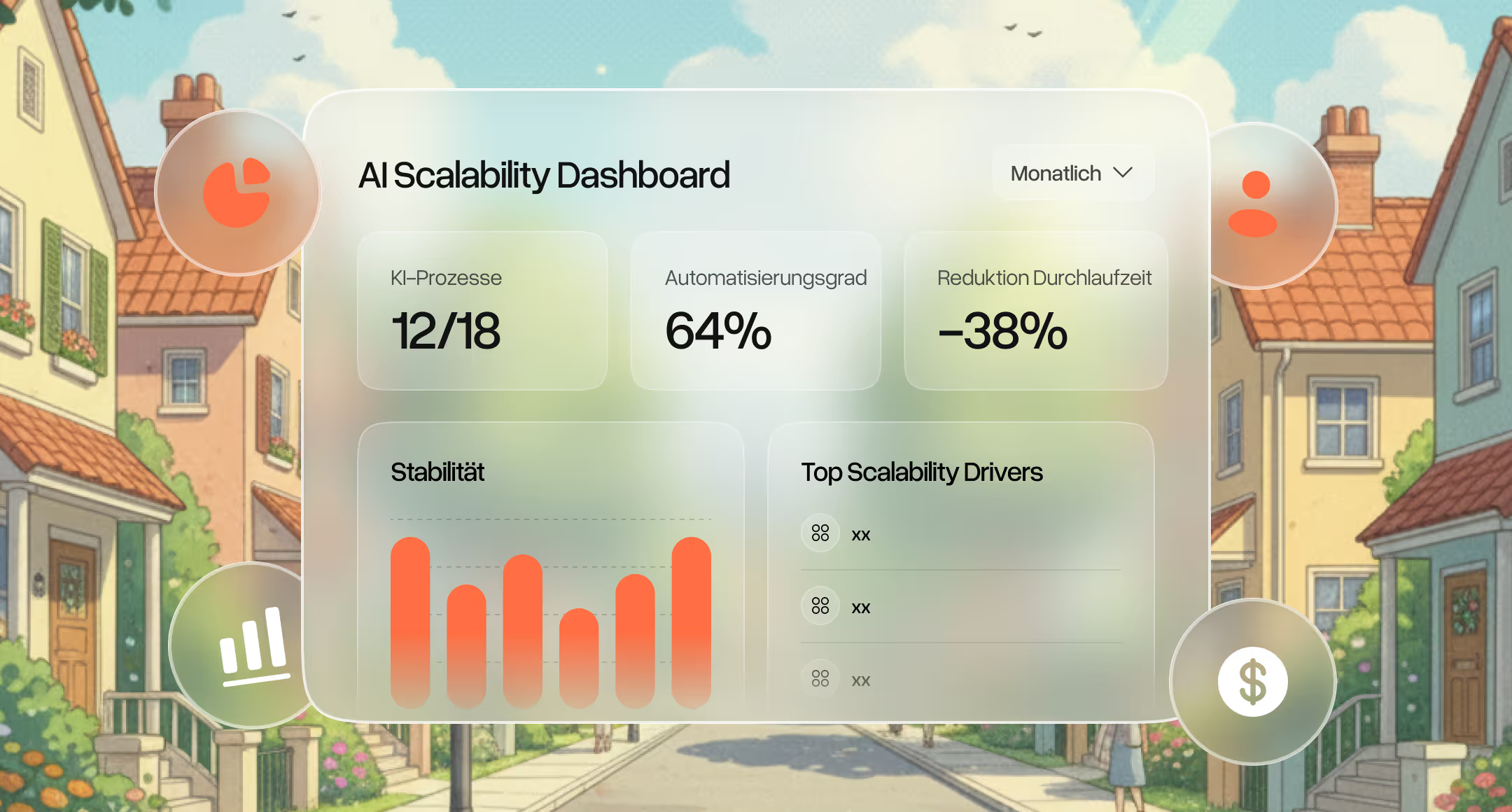
Success measurement becomes granular: No longer "efficiency gains", but "23% shorter contract processing time" or "€8,500 savings per month through automated invoice auditing".
Quick Wins over Moonshots: Instead of waiting for the perfect company-wide AI operating system, small, quickly effective automations are prioritized.
Clear Ownership: Every AI project needs an owner who is responsible for both technical implementation and business impact.
The biggest mistake? Starting AI projects without clear success criteria. Define beforehand which metric should improve and by how much – and continuously measure.
Domain-specific AI: From General-Purpose Model to Specialist
Generic Large Language Models like GPT-4 or Claude remain important, but by 2026, more and more companies will be relying on industry-specific AI models. The reason: higher accuracy, fewer hallucinations, better compliance.
Practical examples:
- Medicine: Models trained on medical publications and making diagnostic suggestions
- Legal: Systems that review contracts according to industry- and country-specific standards
- Industry: AI that interprets machine data and provides precise maintenance recommendations
For mid-sized companies, this means: Check if specialized solutions already exist for your industry before fine-tuning a model yourselves. The barrier to entry drops significantly once providers like Anthropic or European startups provide industry-ready models.
AI Competencies: The Critical Bottleneck
All trends for 2026 have one thing in common: they will fail without qualified teams. In Germany, there are currently thousands of open AI positions, but a massive shortage of skilled workers. The solution is not in recruiting, but in targeted upskilling existing teams.
Particularly in demand are:
- Prompt Engineering: The ability to precisely control AI systems
- AI Governance: Compliance, risk management, documentation
- Workflow-Design: Structuring processes for AI compatibility
- Change Management: Preparing teams for autonomous systems
Many of these skills can be developed in just a few weeks – with structured training and practical exercises. Companies that successfully scale in 2026 will invest at least as much in people as in technology.
Conclusion: 2026 will distinguish experimenters from implementers
The AI Trends 2026 make it clear: The time for proof-of-concepts is over. Companies must now deliver – with autonomous agents, scalable hyperautomation, professional governance, and measurable ROI.
The best way to start: Choose a clearly defined process, implement an initial automation, and gradually develop it further. This way, you'll gain practical experience, build skills, and immediately see where further potential can be unlocked.
You can find more practical workflows in our article on 5 AI Workflows That Save Time Immediately.
Those who invest now – in technology, governance, and especially in people – will optimally position themselves for the next decade of AI-driven value creation.
FAQ: Frequently Asked Questions about AI Trends 2026
What are the AI trends for 2026?
The five most important AI trends for 2026 are: Agentic AI (autonomous AI agents), hyperautomation of end-to-end processes, EU AI Act compliance as a competitive factor, strict ROI focus instead of experiments, and domain-specific AI models for higher precision.
What will AI be in 2026?
In 2026, AI will evolve from a pilot project into productive enterprise infrastructure. The focus will be on measurable results, autonomous workflows, and professional governance. AI will become the strategic operating system for processes and decisions.
What is the best AI in 2026?
There is no "best" AI – the choice depends on the use case. For generic tasks, Large Language Models like GPT-4 or Claude remain relevant. For specialized requirements, companies are increasingly relying on domain-specific models with higher accuracy.
What trend is coming in 2026?
The most important trend is Agentic AI: autonomous AI systems that independently plan and execute complete workflows. According to Gartner, by the end of 2028, at least 15% of all corporate decisions will be made by such systems.
How do I prepare my team for AI trends in 2026?
Invest in targeted training: Prompt Engineering, AI Governance, Workflow Design, and Change Management. Start with practical projects where teams can gain direct experience. Find out more in our guide AI Ready: How to prepare a team for the introduction of AI tools.
Posted by:

Jens is the co-founder of bakedwith, a boutique consultancy firm specialising in smart automation and AI. He helps medium-sized companies and corporations to optimise processes, reduce manual work and achieve growth through efficient workflows. Previously, he was Growth Lead at OMR and worked as a freelancer, helping numerous companies optimise their CRM and automation systems. Jens is passionate about combining growth and efficiency to enable teams to focus on what matters most.